
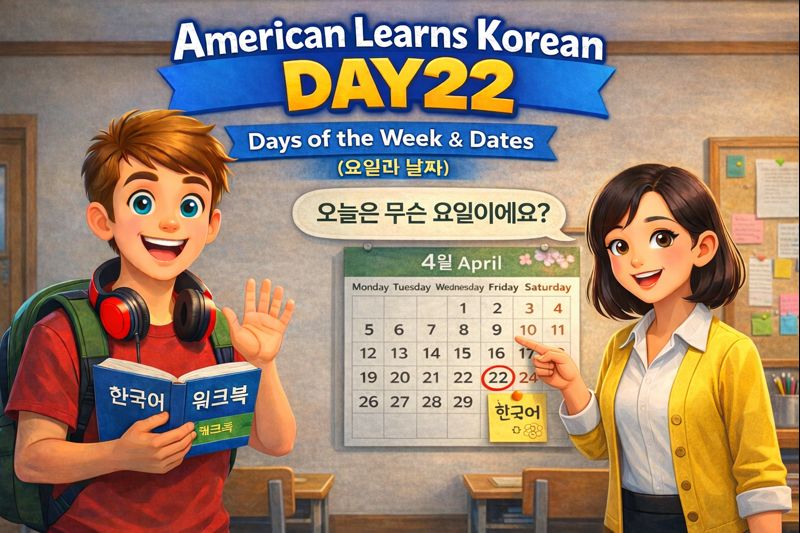
If Day21 helped you say the time (시/분/초), American Learns Korean Day22 completes the “when” package: days of the week and calendar dates. You’ll use this for appointments, travel, deliveries, school schedules, and everyday texting.
The best part: Korean date language is highly systematic. Once you learn the building blocks, you can say almost any date clearly and naturally.
American Learns Korean Day22
1) Today’s Goals (Practical Outcomes)
By the end of Day22, you will be able to:
- Say Monday–Sunday smoothly
- Answer these instantly:
- 오늘 몇 월 며칠이에요? (What’s the date today?)
- 오늘 무슨 요일이에요? (What day is it today?)
- Use scheduling particles naturally: ~에 (on), ~부터 ~까지 (from…to/until…)
- Use relative date words like 오늘/내일/어제/모레 confidently
- Avoid the most common mistake: using Native numbers for calendar dates
2) The One Rule You Must Know
Months and calendar dates use Sino-Korean numbers (일/이/삼…), not Native Korean numbers (하나/둘/셋…).
Examples:
- 12월 23일 → 십이월 이십삼일
- 3월 1일 → 삼월 일일
- 10월 9일 → 십월 구일 (spoken often as 시월 구일)
This connects directly to Day19 (Sino-Korean numbers).
3) Days of the Week (월화수목금토일)
Memorize these first.
- 월요일 = Monday
- 화요일 = Tuesday
- 수요일 = Wednesday
- 목요일 = Thursday
- 금요일 = Friday
- 토요일 = Saturday
- 일요일 = Sunday
Natural short form (very common)
In casual speech, Koreans often shorten them to:
- 월/화/수/목/금/토/일
But for beginners (and for writing), default to the full form: ~요일.
4) Dates in Korean: 년 / 월 / 일
These three words are your date system:
- 년 = year
- 월 = month
- 일 = day of month (date)
Examples:
- 2025년 12월 23일
- 12월 25일
- 1월 1일
Months (1–12월)
Months are simply number + 월.
- 1월 일월
- 2월 이월
- 3월 삼월
- 4월 사월
- 5월 오월
- 6월 유월
- 7월 칠월
- 8월 팔월
- 9월 구월
- 10월 십월 (often pronounced 시월)
- 11월 십일월
- 12월 십이월
5) “며칠” vs “몇 일” (A real-life distinction)
This matters a lot in scheduling conversations.
- 며칠 = the date (as in “What date is it?”)
- 오늘 몇 월 며칠이에요? (What’s today’s date?)
- 몇 일 = how many days (duration)
- 여행 몇 일 가요? (How many days are you traveling?)
In English both can feel like “how many days,” but in Korean, date vs duration often separates like this.
6) Must-Know Relative Date Words
These make your Korean sound much more natural than always saying full dates.
- 오늘 = today
- 내일 = tomorrow
- 어제 = yesterday
- 모레 = the day after tomorrow
- 그저께 = the day before yesterday
- 이번 주 = this week
- 다음 주 = next week
- 지난 주 = last week
7) The Two Essential Questions
These two questions cover most date/day situations:
- 오늘 몇 월 며칠이에요? = What’s the date today?
- 오늘 무슨 요일이에요? = What day is it today?
8) Scheduling Particles That Make You Sound Natural
~에 (on/at)
Use ~에 with a specific day/date/time.
- 금요일에 만나요. (Let’s meet on Friday.)
- 12월 25일에 출발해요. (I leave on Dec 25.)
~부터 ~까지 (from…to/until…)
- 월요일부터 금요일까지 일해요. (I work Monday to Friday.)
- 12월 20일부터 12월 23일까지 여행해요. (I travel from Dec 20 to Dec 23.)
9) Micro Lesson Script (Repeat Twice)
Read once slowly, then at normal speed.
T: 오늘 무슨 요일이에요?
S: 오늘 화요일이에요.
T: 오늘 몇 월 며칠이에요?
S: 오늘 12월 23일이에요.
T: 그럼 내일은요?
S: 내일은 12월 24일, 수요일이에요.
10) Drill 1 — Days of the Week Speed Drill (30 seconds)
Say the full form quickly:
월요일 → 화요일 → 수요일 → 목요일 → 금요일 → 토요일 → 일요일
Goal: one round in 30 seconds. Do 3 rounds.
11) Drill 2 — Date Reading Drill (60 seconds)
Read these out loud in Korean:
- 1월 1일
- 3월 1일
- 5월 5일
- 10월 9일
- 12월 25일
- 12월 31일
Tip: start by splitting into two chunks for clarity:
- “십이월 / 이십오일”
12) Drill 3 — Instant Q&A (45 seconds)
Answer immediately (no translating in your head).
Q: 오늘 무슨 요일이에요?
A: 화요일이에요.
Q: 오늘 몇 월 며칠이에요?
A: 12월 23일이에요.
Q: 금요일에 시간 돼요?
A: 네, 돼요. / 죄송해요, 안 돼요.
Q: 다음 주 화요일에 만날까요?
A: 네, 좋아요.
13) Real-Life Mini Dialogues (Appointments, Travel, Delivery, Work)
Dialogue 1: Appointment
A: 예약 언제 가능해요?
B: 다음 주 화요일 가능해요.
A: 그럼 화요일에 할게요.
Dialogue 2: Travel
A: 여행 언제 가요?
B: 12월 25일에 가요.
A: 며칠 가요?
B: 3일 가요.
Dialogue 3: Delivery
A: 배송은 언제 와요?
B: 금요일에 와요.
A: 금요일 오전에 와요?
Dialogue 4: Work schedule
A: 이번 주에 바빠요?
B: 네, 월요일부터 금요일까지 바빠요.
A: 그럼 토요일에 보죠.
14) Shadowing Practice (10 Lines)
Say each line 3 times.
- 오늘 무슨 요일이에요?
- 오늘 화요일이에요.
- 오늘 몇 월 며칠이에요?
- 오늘 십이월 이십삼일이에요.
- 내일은 수요일이에요.
- 모레는 목요일이에요.
- 금요일에 만나요.
- 월요일부터 금요일까지 일해요.
- 십월 구일에 쉬어요.
- 다음 주 화요일에 예약해요.
15) Homework (10–12 minutes)
Homework A (3 minutes, voice recording)
Record yourself saying:
- Monday–Sunday (two rounds)
- Read dates: 12월 20일 → 12월 25일 (one round)
Homework B (4 minutes, writing)
Write these in Korean:
- Tuesday
- December 25
- January 1, 2026
- From Monday to Friday
Homework C (5 minutes, real-life sentences)
Write 3 true sentences about your schedule:
- “___요일에 만나요.”
- “___월 ___일에 출발해요.”
- “___부터 ___까지 가능해요/바빠요.”
16) Quiz (20 Questions) + Answer Key
Questions (Answer in Korean)
- Monday
- Saturday
- What day is it today?
- What’s the date today?
- January
- December
- 3월 1일
- 10월 9일
- 12월 25일
- 12월 31일
- “Let’s meet on Friday.”
- “I leave on December 23.”
- “I’m busy from Monday to Friday.”
- tomorrow
- yesterday
- next week
- this week
- “Is next Tuesday okay?”
- Which number system is used for months/dates? (Native / Sino-Korean)
- Fill the particle: 금요일__ 만나요.
Answer Key
- 월요일
- 토요일
- 오늘 무슨 요일이에요?
- 오늘 몇 월 며칠이에요?
- 일월
- 십이월
- 삼월 일일
- 십월 구일 (or 시월 구일)
- 십이월 이십오일
- 십이월 삼십일일
- 금요일에 만나요.
- 십이월 이십삼일에 출발해요.
- 월요일부터 금요일까지 바빠요.
- 내일
- 어제
- 다음 주
- 이번 주
- 다음 주 화요일에 시간 돼요?
- 한자어(=Sino-Korean)
- 금요일에 만나요.