
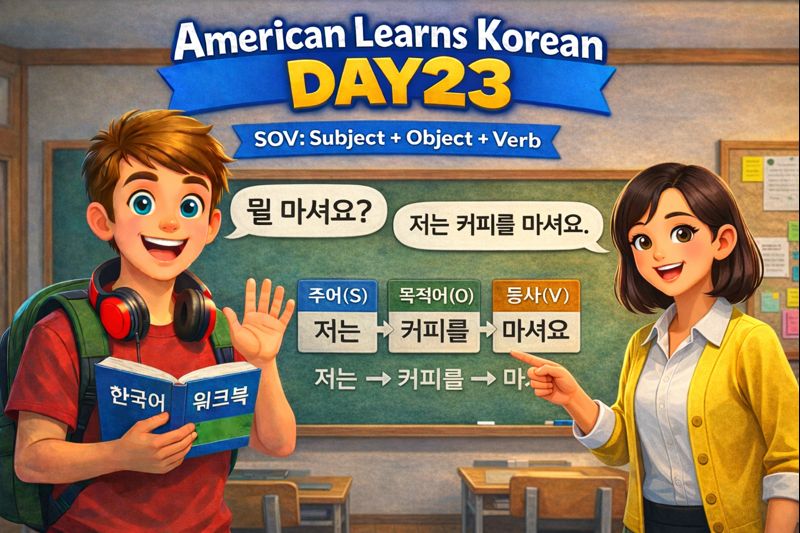
In American Learns Korean Day23, you build the backbone of Korean sentences. English usually follows SVO (Subject–Verb–Object), but Korean is typically SOV (Subject–Object–Verb). Once you lock in this rhythm, you can turn simple vocabulary into complete, natural sentences.
Today’s goal is simple:
- Put the verb at the end automatically
- Use the object particle -을/를 correctly without hesitation
American Learns Korean Day23
1) The Key Idea: Korean Ends with the Verb
Compare:
- English: I eat rice. (S–V–O)
- Korean: 저는 밥을 먹어요. (S–O–V)
Korean stacks information first and delivers the conclusion at the end with the verb. Beginners often stop mid-sentence, so Day23 trains you to speak all the way to the verb.
- Wrong (unfinished): 저는 밥을…
- Right (complete): 저는 밥을 먹어요.
2) The Star of Today: Object Marker -을/를
To mark “what you do something to/with” (the object), Korean commonly uses -을/를.
- If the noun has a final consonant (받침) → -을
- 밥을, 물을, 책을
- If the noun has no final consonant → -를
- 커피를, 사과를, 영화를, 김치를
One-second rule:
Final consonant? → -을
No final consonant? → -를
3) The Day23 Sentence Formula (Use This All Day)
This single formula carries you:
저는/저는요 + [Noun]을/를 + [Verb]-요
Three core sentences to memorize:
- 저는 커피를 마셔요. (I drink coffee.)
- 저는 김치를 먹어요. (I eat kimchi.)
- 저는 책을 읽어요. (I read a book.)
Once you have the frame, you just swap nouns/verbs:
- 저는 물을 마셔요.
- 저는 사과를 먹어요.
- 저는 영화를 봐요.
- 저는 한국어를 공부해요.
4) Do You Always Need the Subject?
In real conversation, if it’s obvious who you’re talking about, Korean often drops the subject:
- Full: 저는 커피를 마셔요.
- Natural (short): 커피를 마셔요.
But today is about structure, so we’ll practice with 저는 first, then shorten later.
5) Mini Lesson Script (Repeat Like a Real Class)
Read each answer twice: once slow, once normal speed.
T: 뭐 먹어요? (What do you eat?)
S: 저는 김치를 먹어요.
T: Good. “김치” has no final consonant, so “김치를.” Again.
S: 저는 김치를 먹어요.
T: 뭐 마셔요? (What do you drink?)
S: 저는 물을 마셔요.
T: Good. “물” has a final consonant, so “물을.” Again.
S: 저는 물을 마셔요.
T: 뭐 읽어요? (What do you read?)
S: 저는 책을 읽어요.
T: Perfect. Verb at the end—finish the sentence in one breath.
S: 저는 책을 읽어요.
6) Drill 1: Swap Drill (30 seconds)
Say each line in one smooth breath—don’t pause before the verb.
- 저는 밥을 먹어요.
- 저는 김치를 먹어요.
- 저는 사과를 먹어요.
- 저는 물을 마셔요.
- 저는 커피를 마셔요.
- 저는 책을 읽어요.
- 저는 영화를 봐요.
- 저는 한국어를 공부해요.
Focus: accuracy first, speed later.
7) Drill 2: 3-Second Instant Answers
Answer immediately using the full Day23 frame.
Q: 뭐 먹어요? → A: 저는 밥을 먹어요.
Q: 뭐 마셔요? → A: 저는 물을 마셔요.
Q: 뭐 봐요? → A: 저는 영화를 봐요.
Q: 뭐 공부해요? → A: 저는 한국어를 공부해요.
Q: 뭐 읽어요? → A: 저는 책을 읽어요.
Do 2 rounds. Your fluency will jump.
8) Drill 3: Fast -을/를 Selection (The Growth Shortcut)
Add the correct particle out loud.
- 물 → 물을
- 밥 → 밥을
- 책 → 책을
- 커피 → 커피를
- 사과 → 사과를
- 김치 → 김치를
- 영화 → 영화를
- 한국어 → 한국어를
Tip: Only check one thing: final consonant or not.
9) Real-Life Mini Dialogues (Café / Restaurant / Study / Hobby)
Dialogue 1: Café
A: 뭐 마셔요?
B: 저는 아메리카노를 마셔요.
A: 디카페인이에요?
B: 아니요, 그냥 커피를 마셔요.
Dialogue 2: Restaurant
A: 뭐 먹어요?
B: 저는 김치를 먹어요.
A: 밥도 먹어요?
B: 네, 밥을 먹어요.
Dialogue 3: Study
A: 뭐 공부해요?
B: 저는 한국어를 공부해요.
A: 매일 해요?
B: 네, 매일 공부해요.
Dialogue 4: Hobby
A: 뭐 봐요?
B: 저는 영화를 봐요.
A: 무슨 영화요?
B: 액션 영화를 봐요.
10) Shadowing Practice (10 Lines)
Say each line 3 times. The goal is to land the verb cleanly at the end.
- 저는 밥을 먹어요.
- 저는 김치를 먹어요.
- 저는 사과를 먹어요.
- 저는 물을 마셔요.
- 저는 커피를 마셔요.
- 저는 책을 읽어요.
- 저는 영화를 봐요.
- 저는 한국어를 공부해요.
- 저는 오늘 한국어를 공부해요.
- 저는 지금 커피를 마셔요.
11) Homework (10–12 minutes)
Homework A (3 minutes, voice recording)
Record yourself saying:
- 저는 밥을 먹어요.
- 저는 물을 마셔요.
- 저는 커피를 마셔요.
- 저는 책을 읽어요.
- 저는 영화를 봐요.
Homework B (4 minutes, writing)
Write 5 sentences using the frame:
저는 + Noun(을/를) + Verb-요
Example: 저는 빵을 먹어요. / 저는 음악을 들어요.
Homework C (5 minutes, real-life use)
Use the pattern twice today (even as self-talk):
- At a café: “저는 아메리카노를 마셔요.”
- At home: “저는 책을 읽어요.”
12) Quiz (20 Questions) + Answer Key
Questions
- I drink water.
- I eat kimchi.
- I read a book.
- I watch a movie.
- I study Korean.
- Fill: 물__ 마셔요.
- Fill: 커피__ 마셔요.
- Fill: 책__ 읽어요.
- Fill: 김치__ 먹어요.
- Fill: 영화__ 봐요.
- Which particle after a final consonant noun? (-을 / -를)
- Which particle after a no-final-consonant noun? (-을 / -를)
- English sentence order is usually (SVO / SOV).
- Korean basic order is (SVO / SOV).
- Write one answer to “뭐 먹어요?”
- Write one answer to “뭐 마셔요?”
- Write one answer to “뭐 읽어요?”
- Write one answer to “뭐 봐요?”
- “한국어” takes which particle? (-을 / -를)
- “밥” takes which particle? (-을 / -를)
Answer Key
- 저는 물을 마셔요.
- 저는 김치를 먹어요.
- 저는 책을 읽어요.
- 저는 영화를 봐요.
- 저는 한국어를 공부해요.
- 물을 마셔요.
- 커피를 마셔요.
- 책을 읽어요.
- 김치를 먹어요.
- 영화를 봐요.
- -을
- -를
- SVO
- SOV
- Example: 저는 밥을 먹어요.
- Example: 저는 물을 마셔요.
- Example: 저는 책을 읽어요.
- Example: 저는 영화를 봐요.
- 한국어를
- 밥을