
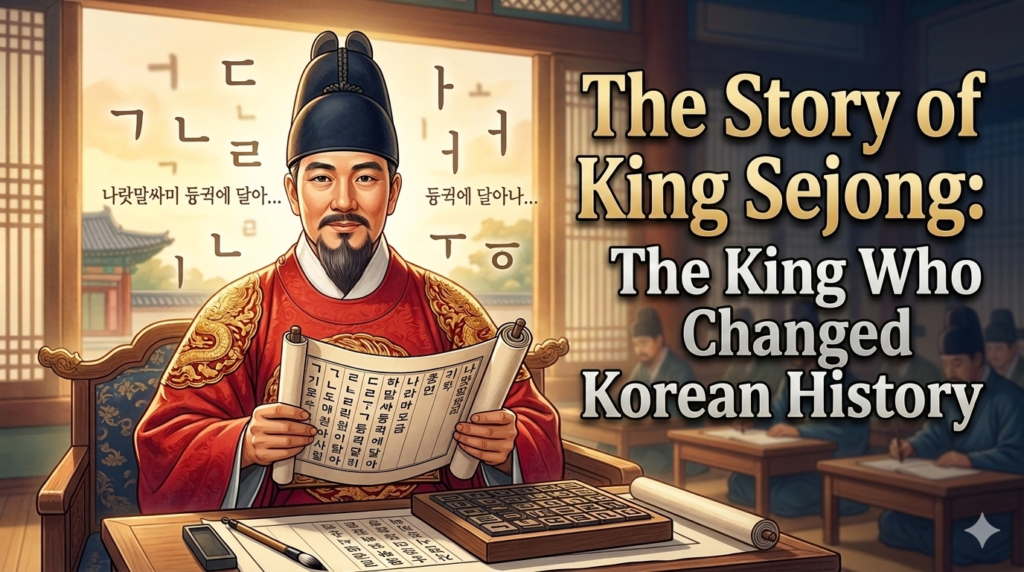
Introduction
When people learn about Korean history, one name appears again and again: King Sejong. For many learners of Korean culture or language, the first question they ask is simple: who was King Sejong and why is he so important? The answer leads directly into The story of King Sejong, a story that goes far beyond a single historical achievement.
King Sejong ruled during the Joseon Dynasty and is widely remembered as the creator of Hangul, the Korean writing system. However, reducing his legacy to only the creation of Hangul would be incomplete. The story of King Sejong is also about leadership, education, and the effort to make knowledge accessible to ordinary people.
Today, King Sejong is one of the most respected figures in Korean history. His influence can be seen not only in language but also in culture, governance, and scholarship. Understanding The story of King Sejong helps readers understand why his legacy continues to shape modern Korea.
Who Was King Sejong?
King Sejong was the fourth king of the Joseon Dynasty, ruling Korea from 1418 to 1450. In historical and cultural sources, he is often referred to as King Sejong the Great, a title that reflects the enormous impact he had on Korean society.
Unlike many rulers remembered mainly for military expansion, The story of King Sejong is centered on intellectual and cultural progress. During his reign, Korea experienced significant developments in scholarship, science, and administration.
Historical records describe him as a king who valued learning and surrounded himself with talented scholars. One of the most well-known institutions during his reign was the Hall of Worthies, a royal research institute where scholars worked on academic and policy projects.
Because of this focus on knowledge and scholarship, The story of King Sejong is often told not only as political history but also as the story of a ruler who believed education should benefit the entire society.
The Creation of Hangul
The most famous part of The story of King Sejong is the creation of Hangul, the Korean alphabet.
Before Hangul existed, written communication in Korea relied largely on Chinese characters. These characters were difficult for many ordinary people to learn because they did not perfectly match the structure of the Korean language.
King Sejong recognized this problem. Many people could speak Korean but could not easily write their own language. To address this issue, he led the development of a new writing system that would represent Korean sounds more accurately.
According to historical sources, the script was completed in 1443 and later published in 1446 in a document called Hunminjeongeum. This document explained the purpose and structure of the new writing system.
The creation of Hangul is the most widely known moment in The story of King Sejong because it dramatically expanded literacy and made written communication more accessible to ordinary people.
Why Hangul Was So Important
To fully understand The story of King Sejong, it is important to look beyond the simple fact that he created a writing system. The deeper significance lies in why he created it.
Before Hangul, reading and writing were largely limited to educated elites who had spent years studying Chinese characters. For common people, learning to write their own language was extremely difficult.
Hangul changed this situation. The new writing system was designed to be logical and easier to learn. Because it represented Korean sounds directly, people could learn to read and write much faster.
As a result, The story of King Sejong is often described as a story about expanding access to knowledge. By creating a writing system suited to the Korean language, Sejong helped open the door to education for a much larger portion of the population.
The Role of Scholars
Another important aspect of The story of King Sejong involves the scholars who worked alongside him.
During his reign, King Sejong established the Hall of Worthies, where scholars conducted research and helped develop intellectual projects. Historical sources suggest that these scholars contributed explanations and commentary for the Hangul system.
However, the central role in the creation of the writing system itself is still attributed to King Sejong. Scholars helped document, explain, and promote the new script, but the vision and leadership behind its creation are associated with the king.
This collaboration between a ruler and scholars highlights another theme in The story of King Sejong: the importance of knowledge and intellectual cooperation in governance.
Why He Is Called “The Great”
Not every king receives the title “the Great.” In the case of Sejong, the title reflects the long-term influence of his reign.
Several factors explain why The story of King Sejong continues to be celebrated today.
First, the creation of Hangul permanently changed the way Korean people read and write. The alphabet is still used today and is considered one of the most logical writing systems in the world.
Second, King Sejong promoted learning and scholarship. His reign supported scientific studies, cultural development, and administrative improvements.
Third, he is remembered as a ruler who cared about the everyday lives of his people. The creation of Hangul itself shows a desire to reduce barriers to communication and education.
Because of these achievements, the title King Sejong the Great reflects not just admiration but historical recognition of his impact.
Why The Story of King Sejong Still Matters
Even centuries later, The story of King Sejong continues to be relevant. Modern Korea still uses Hangul as its national writing system, and Sejong’s influence remains visible in education, language, and culture.
For students learning Korean today, the story is particularly meaningful. Every time a learner reads Hangul, they are using the writing system created during King Sejong’s reign.
In this sense, The story of King Sejong is not only about the past. It is also about the continuing role of language in shaping identity, communication, and culture.
Understanding this story helps learners appreciate the deeper cultural background of the Korean language.
Frequently Asked Questions
Who was King Sejong?
King Sejong was the fourth king of the Joseon Dynasty and is widely known as the creator of Hangul.
Why is King Sejong important?
He created Hangul and promoted learning, making education and written communication more accessible to the public.
What is Hangul?
Hangul is the Korean alphabet developed during King Sejong’s reign.
Why is he called “the Great”?
His achievements in language, education, and governance had a lasting impact on Korean society.
Conclusion
In the end, The story of King Sejong is not just about a king who created a writing system. It is about a leader who believed that knowledge should be accessible to everyone.
By creating Hangul and encouraging scholarship, King Sejong changed the way people communicated and learned. His actions helped shape Korean culture in ways that are still visible today.
That is why his story continues to be told. The story of King Sejong reminds us that leadership is not only about power, but also about improving the lives of ordinary people through knowledge and communication.