
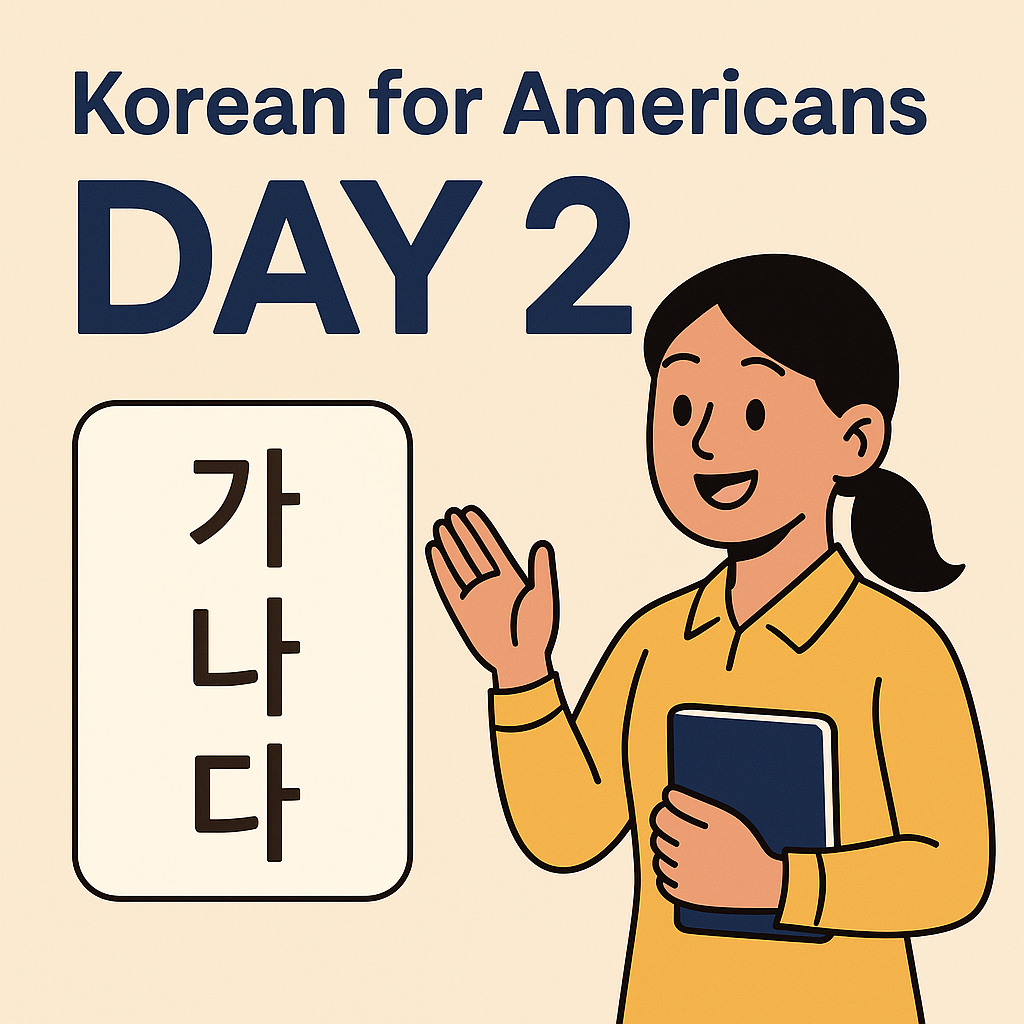
Core Objective for Day 2
The purpose of Korean for Americans Day 2 is simple: stop “decoding” Hangul and start converting what you see into sound instantly. Today, you will not use final consonants (batchim). You will practice only initial consonant + vowel.
Korean is not written as a straight line of letters like English. It combines a consonant and vowel into a single syllable block such as 가/나/다. Once this block system becomes automatic, Day 3 and Day 4 (with batchim and real words) become much easier.
Lock in the 5 Vowels Using Mouth Shape
The fastest way for Korean for Americans Day 2 is to fix vowels by mouth shape, not just by ear.
- ㅏ (아): open vertically, “a”
- ㅓ (어): relaxed “uh” (do not round the lips)
- ㅗ (오): round lips, “oh”
- ㅜ (우): round lips forward, “oo”
- ㅣ (이): “ee”
The two contrasts you must master
English speakers often mix 어(ㅓ) and 오(ㅗ). The fix is direct:
- 어 (ㅓ): lips not rounded, relaxed
- 오 (ㅗ): lips clearly rounded
Practice: say eo–o–eo–o 10 times while watching your lips. Record yourself—if the two sounds are clearly different, you’re on track.
10 Basic Consonants: Distinction First, Perfection Later
If you try to perfect every consonant too early, you slow down and lose the main goal. In Korean for Americans Day 2, focus on distinguishing these consonants:
ㄱ (between g/k), ㄴ (n), ㄷ (between d/t), ㄹ (between r/l), ㅁ (m), ㅂ (between b/p), ㅅ (s), ㅇ (silent at start / ng at end), ㅈ (j), ㅎ (h)
The critical habit: ㄹ for Americans
The biggest trap is pronouncing ㄹ like an English “r” with a curled tongue. Don’t. Start with a light tap of the tongue tip near the ridge behind your front teeth.
Quick check: repeat “ra-ra-ra” fast. If your tongue curls back, slow down and reset.
Build Syllable Blocks: 가/거/고/구/기
This is the main training in Korean for Americans Day 2: “consonant + vowel = one block.” Practice in the easiest order:
- ㄱ set: 가-거-고-구-기
- ㄴ set: 나-너-노-누-니
- ㄷ set: 다-더-도-두-디
- ㅁ set: 마-머-모-무-미
The speed rule (most efficient)
- Read each set slow once (accuracy)
- Read the same set fast twice (automation)
If you start mixing eo/o or u/o, go back to slow reading immediately, then build speed again.
10-Minute Daily Routine (Repeatable and Realistic)
If you can do only one thing, do this routine. It is designed for adults who want progress without long study sessions.
- 아-어-오-우-이 ×2
- 가-거-고-구-기 ×3 (1 slow + 2 fast)
- 나-너-노-누-니 ×2
- 다-더-도-두-디 ×2
- 마-머-모-무-미 ×2
SEO image tip for your blog: set the ALT text to something like “Korean for Americans Day 2 Hangul vowels consonants practice” so the image supports the focus keyword naturally.
10 Essential Practice Words (Reading Speed)
For Korean for Americans Day 2, meaning is secondary. These words are chosen because they are easy to repeat and help your brain link “letters → sound.”
아 / 오 / 우 / 이 / 나 / 너 / 뭐 / 네 / 아니요 / 어디
3-minute mini test
Read these instantly: 아니요 / 어디 / 너 / 네 / 뭐
If you pause longer than 2 seconds, isolate that word and repeat it 10 times.
Short Dialogue: Build Rhythm in Your Mouth
This short dialogue is ideal for shadowing (repeat after audio or after yourself). It’s short, common, and contains Day 2 words.
A: 안녕?
B: 안녕.
A: 너 이름 뭐야?
B: 나 ___야.
A: 네.
Don’t focus on translating. Focus on rhythm and linking. Instead of trying to say the whole question at once, chunk it:
- “너 이름 / 뭐야?”
- “나 / ___야.”
Repeat the chunks, then connect them.
4 Common Mistakes (Stop Them Early)
Most Day 2 problems are predictable. Fix these early and Day 3 becomes easier.
- Rounding 어(ㅓ) like 오(ㅗ)
- 어 is not rounded. Keep it relaxed.
- Mixing 우(ㅜ) and 오(ㅗ)
- 우 pushes the lips more forward (“oo”).
- 오 is rounded but more back (“oh”).
- Hardening ㄱ/ㄷ/ㅂ into pure k/t/p
- Korean often sits between voiced and voiceless.
- Today, clear distinction is enough.
- Reading blocks as separate pieces (“ㄱ…ㅏ…”)
- Don’t assemble it slowly. Say 가 as one unit.
30-second correction drill
Repeat these pairs quickly:
eo–o–eo–o / o–u–o–u / ga–geo–ga–geo / na–neo–na–neo
15-Minute Assignment: One Recording for Fast Feedback
The fastest way to improve is not longer practice—it’s short practice + recording. Record this in one take:
- 아-어-오-우-이
- 가-거-고-구-기
- 나-너-노-누-니
- “너 이름 뭐야? / 나 ___야.”
After listening, check only two things:
- Are ㅓ (어) and ㅗ (오) clearly separated?
- Is ㄹ being pronounced like an English r (tongue curled)? If yes, reset and retap.
핑백: Korean for Americans Day 3 - Brown-Sugar
핑백: American Learns Korean Day15: If You Can Pay Smoothly, Korean Feels Easy | Brown-Sugar