
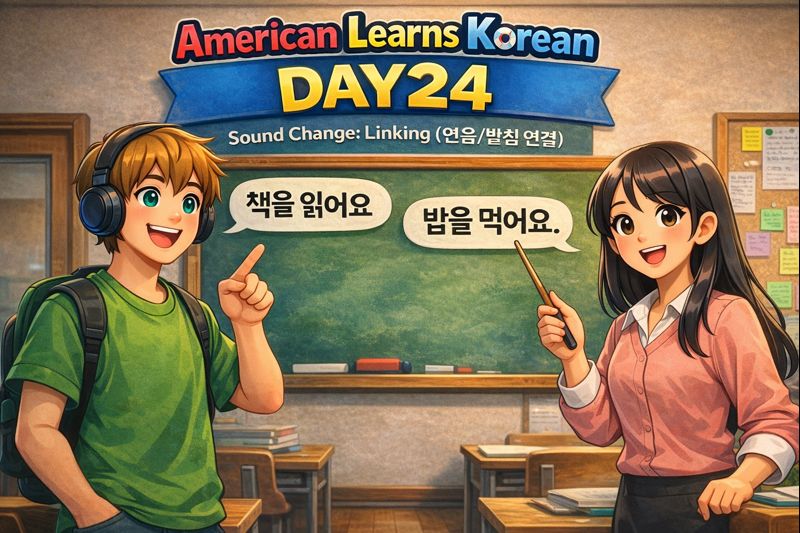
American Learns Korean Day24 in one sentence
Korean often sounds “faster” because sounds link across syllables—today you’ll stop reading word-by-word and start reading by sound flow.
Today’s goals
- Learn the core pattern of linking (연음 / 받침 연결) in real sentences.
- Move from “spelling reading” to “sound reading.”
- Build a simple routine to self-correct using recordings.
You’ll keep the Day23 sentence structure (Subject + Object + Verb) but make it sound natural.
What is 연음 (linking / batchim connection)?
Many beginners read Korean like English: clean pauses between words. Korean speech often does the opposite—it connects.
When the next syllable starts with ㅇ, the previous syllable’s final consonant (받침) tends to attach forward in your mouth movement.
Key idea:
- You are not changing the spelling.
- You are simply removing the “stop” between syllables.
Rule 1: 받침 + ㅇ → read it as one connected flow
Don’t memorize “special pronunciations.” Instead, train no-gap linking.
Here are common examples (right side is a rhythm hint, not official spelling):
| Written (Korean) | Beginner “choppy” reading | Natural rhythm (connection hint) |
|---|---|---|
| 책을 | 책-을 | 채글 (connected feel) |
| 밥을 | 밥-을 | 바블 (connected feel) |
| 한국어 | 한-국-어 | 한구거 (less breaking) |
| 읽어요 | 읽-어-요 | 일거요 (connected feel) |
| 먹어요 | 먹-어-요 | 머거요 (connected feel) |
| 집에 | 집-에 | 지베 (connected feel) |
Important: The goal is not to “force” 채글/바블.
The goal is to stop doing 책-을 / 밥-을 with a hard cut.
Rule 2: You must train this in sentences (not just words)
You might do fine with a single word—but collapse in real speech because sentences add:
- breathing
- intonation
- speed pressure
So today you train with Day23-style sentences:
- 저는 책을 읽어요. (I read a book.)
- 저는 밥을 먹어요. (I eat rice/meal.)
- 저는 물을 마셔요. (I drink water.)
- 저는 한국어를 배워요. (I learn Korean.)
Today’s success metric is not speed.
It’s one breath, fewer breaks.
The 3-step correction method (do it in this order)
Linking improves fastest with structured repetition.
- Slow + accurate: keep spelling correct, remove hard breaks
- Normal speed + connected: read the whole sentence as one unit
- Natural speed + rhythm: add intonation; keep the verb ending clear
Five minutes of this reduces the “Korean is too fast” feeling immediately.
Lesson script (teacher-style coaching)
Teacher: Today is linking (연음). If you cut between words, Korean sounds robotic. Your job is to keep the flow.
Student: I read it like “책-을 / 읽-어-요.”
Teacher: Good start. Now remove only the breaks. Say “책을” in one go, and “읽어요” in one go.
Student: “책을 읽어요.”
Teacher: Much better. Don’t exaggerate—just reduce the stopping. Now include “저는” too: “저는 책을 읽어요.”
Student: “저는 책을 읽어요.”
Teacher: Great. Same pattern with “밥을 먹어요.”
Drill 1: One-breath rhythm drill (60 seconds)
Rule: Do not stop inside the sentence. Stop only at the end.
Each sentence 3 times: (1) slow → (2) normal → (3) natural
- 저는 책을 읽어요.
- 저는 밥을 먹어요.
- 저는 물을 마셔요.
- 저는 한국어를 배워요.
If you catch yourself doing “책-을 / 밥-을,” restart from slow.
Drill 2: Micro linking drill (40 seconds)
This trains only the “sticky” spots.
Rule: small voice, short reps, many times
- 책을 / 책을 / 책을
- 밥을 / 밥을 / 밥을
- 읽어요 / 읽어요 / 읽어요
- 먹어요 / 먹어요 / 먹어요
- 한국어 / 한국어 / 한국어
Tip: If you speak loudly, you often break more. Keep it light and connected.
Drill 3: Sentence swap drill (keep S + O + V)
Replace only the object and make 10 sentences.
- 저는 ___을/를 읽어요.
- 저는 ___을/를 먹어요.
- 저는 ___을/를 마셔요.
Examples:
- 저는 신문을 읽어요. (I read a newspaper.)
- 저는 김밥을 먹어요. (I eat gimbap.)
- 저는 커피를 마셔요. (I drink coffee.)
Why this works: changing the object creates many new linking moments in real speech.
5 common mistakes (and how to fix them fast)
- Over-exaggerating the “connected” sound
→ Fix: Don’t chase “채글/바블.” Chase no hard breaks. - Stress every word (English habit) → causes breaks
→ Fix: Keep it smooth; make the final verb ending the clearest. - Speed up → pronunciation gets muddy
→ Fix: Don’t speed up yet. Master connection first. - Pausing on batchim words
→ Fix: Don’t stop on the 받침—carry into the next syllable. - Not sure if you’re correct → anxiety
→ Fix: Use recording + break-check (homework). It removes guessing.
Homework (5 minutes, prepares Day25)
- Record each sentence for 10 seconds (total 40 seconds).
- Listen and mark where you break (ex: 책-을, 밥-을).
- Re-record only the marked sentences two more times.
Sentences:
- 저는 책을 읽어요.
- 저는 밥을 먹어요.
- 저는 물을 마셔요.
- 저는 한국어를 배워요.
Day25 will go further into more complex sound changes (assimilation / 겹받침). If Day24 is solid, Day25 feels much easier.
Quiz: Linking (연음) Check (10 Questions)
Use this quiz to confirm you truly understand the “no-break” habit. Answers and explanations are below.
Part A. Multiple Choice (1–5)
1) What is the main goal of 연음 practice in Day24?
A. Change the spelling to match the sound
B. Remove hard breaks and keep one connected flow
C. Speak as fast as possible
D. Memorize 20 pronunciation rules
2) Linking happens most strongly in today’s lesson when the next syllable starts with:
A. ㄱ
B. ㅁ
C. ㅇ
D. ㅅ
3) Which reading habit most often makes Korean sound “robotic”?
A. Clear verb endings
B. Soft intonation
C. Cutting between words/syllables
D. Speaking quietly
4) Which is the best practice order for linking?
A. Natural → Normal → Slow
B. Slow → Normal → Natural
C. Normal → Natural → Slow
D. Only natural speed
5) Which sentence best matches the Day23 structure (Subject + Object + Verb)?
A. 책! 읽어요!
B. 저는 한국어.
C. 저는 책을 읽어요.
D. 읽어요 저는 책을.
Part B. Fill in the blanks (6–8)
Write the correct particle and verb ending.
6) 저는 물___ 마셔요.
7) 저는 밥___ 먹어요.
8) 저는 한국어___ 배워요.
Part C. “Spot the Break” (9–10)
Choose where beginners most often break incorrectly.
9) 저는 책을 읽어요.
A. 저는 / 책을 / 읽어요 (breaks everywhere)
B. 저는 책을 / 읽어요 (one mid break)
C. 저는 책을 읽어요 (no internal break)
D. 저는책을읽어요 (mumbled, no word boundaries)
10) 저는 밥을 먹어요.
A. 저는 / 밥-을 / 먹어요 (hard cut on 밥을)
B. 저는 밥을 먹어요 (smooth)
C. 저는 밥을 / 먹어요 (mid break)
D. All are equally good
Quiz Answers + Explanations
1) B — Day24 is about removing hard cuts, not rewriting spelling.
2) C — In this lesson, 받침 + 다음 음절 초성 ㅇ is the key linking trigger.
3) C — Over-cutting is the #1 reason Korean sounds unnatural.
4) B — Start slow (accurate), then connect at normal speed, then add natural rhythm.
5) C — “저는(Subject) 책을(Object) 읽어요(Verb)” is the standard S+O+V pattern.
6) 을 — “물을” (object particle).
7) 을 — “밥을” (object particle).
8) 를 — “한국어를” (object particle).
9) C — The goal is one connected flow with no internal stops; D is too mumbled.
10) B — Smooth is best; A is the classic incorrect hard cut at 밥-을.
Checklist (your “done” standard for today)
- I did not hard-stop at “책-을 / 밥-을.”
- I kept the sentence smooth and ended the verb clearly.
- I found at least one break point in my recording.
- I re-recorded the problem sentence twice with fewer breaks.
FAQ
Q1. Do I have to memorize linking rules?
A. Not first. Day24 is about building a no-break habit, not memorizing many rules.
Q2. Is “채글/바블” the correct pronunciation?
A. Treat it as a rhythm hint. The real target is connected flow, not forcing that exact sound.
Q3. Korean sounds too fast. Will this help listening?
A. Yes. Once you understand linking, speech feels less “fast” and more “connected,” which improves listening quickly.