
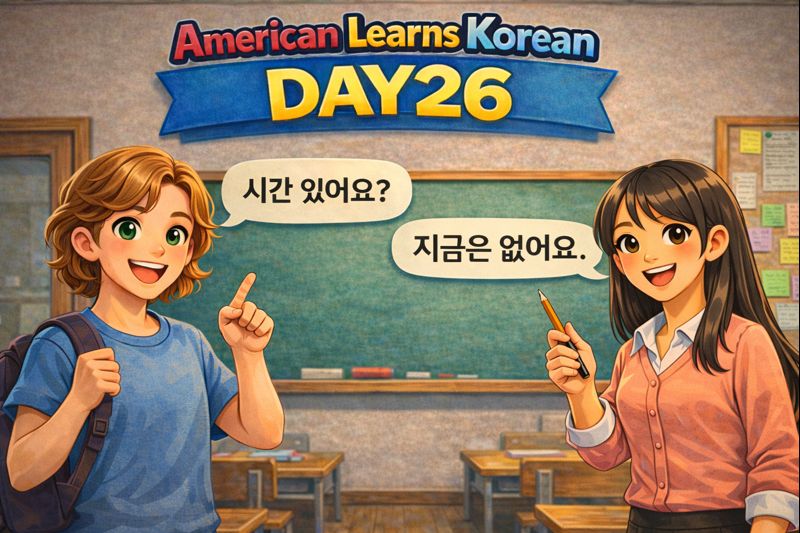
American Learns Korean Day26 goals
Day26 is about reaching a new stage: Hangul on the page becomes a real conversation in your head—without translating first.
Today you will:
- Read 6 Hangul-only mini dialogues smoothly (fewer breaks mid-line).
- Apply Day24–25 sound changes (linking/assimilation/tensing/ㅎ effects) as rhythm, not theory.
- Use recording to build a simple self-correction loop.
Rule for today:
Read first, understand second.
Once your reading flow improves, meaning follows faster.
5 reading rules for today
- One line = one breath (no stopping mid-line)
- Questions end with a slight rise (“요?”)
- Answers end with a clear fall (“요.”)
- Keep endings clear: 예요/이에요/돼요/있어요/없어요
- Slow is fine. Fewer breaks matters more than speed.
Mini Dialogue 1: Café
A: 아메리카노 주세요.
B: 아이스요, 따뜻한 거요?
A: 아이스요.
B: 카드 돼요?
A: 네, 돼요.
Mini Dialogue 2: Convenience Store
A: 물 있어요?
B: 네, 있어요.
A: 이거 얼마예요?
B: 천오백 원이에요.
A: 봉투 주세요.
Mini Dialogue 3: Classroom
A: 이거 뭐예요?
B: 책이에요.
A: 한국어 어려워요.
B: 괜찮아요. 천천히 해요.
Mini Dialogue 4: Asking Directions
A: 화장실 어디에 있어요?
B: 저쪽에 있어요.
A: 감사합니다.
B: 네, 괜찮아요.
Mini Dialogue 5: Restaurant
A: 여기 앉아도 돼요?
B: 네, 돼요.
A: 물 좀 주세요.
B: 네, 알겠어요.
Mini Dialogue 6: Phone/Text Style
A: 지금 시간 있어요?
B: 지금은 없어요.
A: 언제 괜찮아요?
B: 내일 괜찮아요.
Pronunciation focus (only 3 points)
Do not overload. Today, check only these:
- 카드 돼요: keep it connected—don’t break between “카드 / 돼요.”
- 없어요: don’t read too choppy; aim for smooth flow.
- 천오백 원이에요: numbers + unit should sound like one chunk (avoid heavy cuts).
Teacher-style coaching script
Teacher: Today, don’t translate first. Read it like sound. One line, one breath.
Student: “아메리카노 주세요.”
Teacher: Good. Now the next line—don’t cut it into parts. Read it as one question: “아이스요, 따뜻한 거요?”
Student: “아이스요, 따뜻한 거요?”
Teacher: Great—raise your tone slightly at the end because it’s a question. Now read Dialogue 1 as A/B roles like a real conversation.
Drill 1: Line Reading (2 minutes)
Goal: one line = one breath
- Dialogue 1 × 2 (slow but no mid-line stops)
- Dialogue 2 × 2
- Dialogue 3 × 2
Check:
- Don’t break in “이거 얼마예요?”
- “천오백 원이에요” = one chunk
- Keep endings clear: 예요/이에요/돼요/있어요
Drill 2: Role Switching (2 minutes)
Read A-only, then B-only, then alternate.
- Round 1: A role only (Dialogues 1–3)
- Round 2: B role only (Dialogues 1–3)
- Round 3: A/B alternating (Dialogue 1 only)
Point:
- A = more requests/questions → tone rises slightly
- B = more confirmations/answers → tone falls clearly
This alone makes your reading sound conversational.
Drill 3: 10-second “flow drill”
Read these without stopping inside the line. The goal is flow, not speed.
- 물 있어요? 네, 있어요.
- 카드 돼요? 네, 돼요.
- 지금 시간 있어요? 지금은 없어요.
If these 3 lines feel automatic, cafés and convenience stores become much easier.
Quiz (10 questions)
Multiple Choice (1–5)
1) Day26’s core rule is:
A. Translate first
B. Read with heavy breaks
C. Read first (Hangul-only), understand second
D. Memorize complex phonetics
2) Question intonation usually:
A. Falls
B. Rises slightly
C. Stays flat
D. Must be shouted
3) Which is best read as one chunk?
A. 천 / 오 / 백 / 원 / 이 / 에 / 요
B. 천오백 원이에요
C. 천오백 / 원 / 이에요 (strong cut)
D. 천오 / 백원이 / 에요
4) The goal with “없어요” practice is:
A. Stop after every syllable
B. Speak louder
C. Reduce breaks and keep smooth flow
D. Say it in English first
5) Why do endings matter (예요/돼요/있어요)?
A. If endings blur, meaning becomes unclear
B. It looks prettier
C. It makes you sound fast
D. You must always speak loudly
True/False (6–10)
6) “카드 돼요?” is a question, so tone rises slightly. ( )
7) “네, 돼요.” sounds more natural when stretched long. ( )
8) Hangul-only reading is only about speed, not flow. ( )
9) “이거 얼마예요?” sounds more conversational with fewer breaks. ( )
10) Today is about repetition and rhythm, not memorizing many rules. ( )
Answer Key:
- C 2) B 3) B 4) C 5) A
- True 7) False 8) False 9) True 10) True
Homework (5–7 minutes)
- Choose 2 dialogues out of the 6.
- Record yourself reading A/B alternation for 25 seconds each (total ~50 seconds).
- Listen and check only 3 things:
- Did I stop mid-line?
- Did my question tone rise slightly?
- Are endings (돼요/예요/있어요/없어요) clear?
- Re-record each chosen dialogue one more time with fewer breaks.
핑백: American Learns Korean Day27: Month 1 Hangul Reading Quiz (Beginner Checkpoint) | Brown-Sugar