
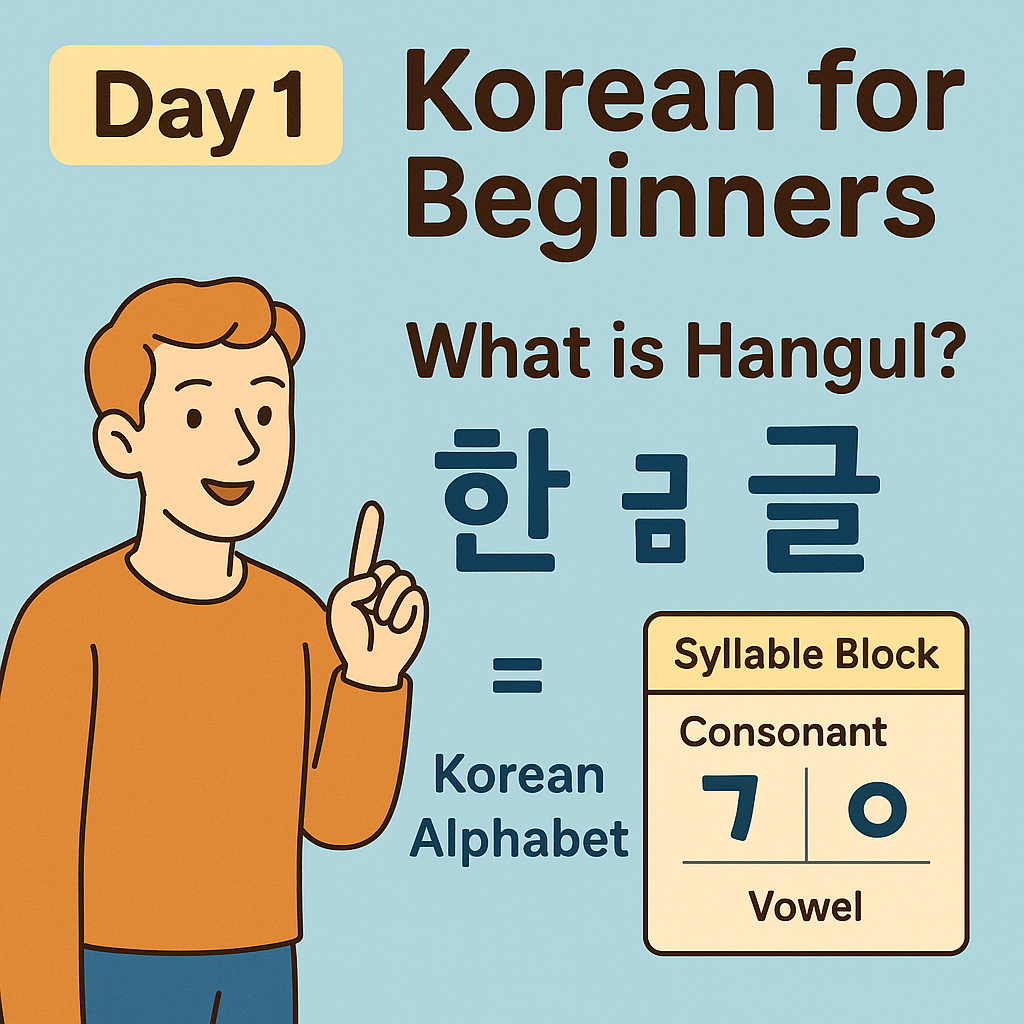
Day 1 – Korean for Beginners: What Is Hangul and How Do You Start?
When English speakers search for Korean for beginners Day 1, they usually have one big question in mind: “How on earth do I read these characters?”
In this first lesson, we will answer that question clearly and guide you from zero to your very first real Korean words, using simple but accurate explanations.
Why Korean for beginners Day 1 must start with Hangul
The most common mistake for English learners is to skip Hangul and only memorize random phrases like “annyeonghaseyo.” It feels good at first because you can say a few sentences, but without reading skills you quickly hit a wall.
That is why this Korean for beginners Day 1 lesson starts with Hangul, the Korean alphabet. Hangul is not like Chinese characters that require thousands of symbols. It is a phonetic alphabet. Once you know the basic consonants and vowels, you can already sound out almost any Korean word, even if you do not know the meaning yet.
As soon as you understand this, Korean stops being a scary “memory hell” and becomes a language with rules you can learn step by step.
Hangul in one simple picture
It becomes much easier if you compare Hangul with the English alphabet.
- In English, you write letters like A, B, C in a straight horizontal line.
- In Korean, letters are grouped into small square blocks that look like single characters.
However, both systems follow the same basic idea:
consonant + vowel = one sound
For example, in English “ka” is made from k + a.
In Korean, the syllable “가 (ga)” is made from ㄱ + ㅏ inside one square block.
So the main goal of Korean for beginners Day 1 is to help you feel how these blocks work: how consonants and vowels are stacked together to form a clean, logical shape that represents one syllable.
How Korean syllable blocks are built
Let’s zoom in on a single block and look at its structure.
Most Hangul syllables follow this pattern:
- Initial position – always a consonant
- Middle position – a vowel that creates the main sound
- Final position (optional) – another consonant at the bottom, called batchim
Take the syllable 안 (an) as an example:
- ㅇ = initial consonant (silent in this position, just a placeholder)
- ㅏ = vowel “a” as in “father”
- ㄴ = final consonant “n”
All three letters are arranged into one square, 안. With your eyes you see one block, but in reality it contains three alphabet pieces. Understanding this hidden structure is one of the key points of Korean for beginners Day 1.
Your first real word: 안녕하세요
Now let’s look at a word you have probably heard before:
안녕하세요 (annyeonghaseyo) – the most common polite greeting in Korean.
It is written as five syllable blocks:
- 안 – an
- 녕 – nyeong
- 하 – ha
- 세 – se
- 요 – yo
Each block takes exactly one beat. If you point at each block with your finger and read slowly, you will feel the rhythm:
an – nyeong – ha – se – yo
At this stage you do not need to memorize every single letter name.
For Korean for beginners Day 1, the important thing is to experience the shape, sound, and rhythm together. Train your brain to think “one square = one beat.”
First contact with Korean vowels
Korean vowels may look complicated at first, but they are built from only a few simple elements:
- A horizontal line ㅡ
- A vertical line ㅣ
- Short strokes attached to those lines
For example:
- ㅏ = similar to “a” in “father”
- ㅗ = similar to “o” in “go” (but shorter)
- ㅣ = similar to “ee” in “see”
These vowels soon combine with consonants to form many different syllables.
In Korean for beginners Day 1, you do not have to master all of them. It is enough to notice that Hangul shapes are just clean lines and short strokes arranged by rules, not pieces of complicated art.
Two powerful words you can use from Day 1
Let’s learn two ultra-useful words you will hear in almost every conversation. They are simple, but perfect for Korean for beginners Day 1 because you can start using them immediately.
1) 네 (ne) – “Yes”
- Pronounced like “neh”
- Extremely common and very flexible in meaning
- Can mean “yes,” “right,” “I see,” or “okay”
When someone explains something to you, nod your head and say “네, 네.”
You are showing that you are listening and that you understand, just like saying “right, right” in English.
2) 아니요 (aniyo) – “No”
- Written as three blocks: 아 – 니 – 요
- Pronounced “ah-nee-yo”
If a friend asks, “Coffee?” and you do not want any, you can simply say “아니요.”
Use a soft tone and it becomes a polite, natural way to refuse.
By mastering just these two words, you already gain clear control over “yes” and “no” at the Korean for beginners Day 1 level.
A 10-minute practice routine for Day 1
Here is a short routine that will help today’s lesson stick in your long-term memory.
- Reading practice
- Read aloud: 안녕하세요 / 네 / 아니요
- Touch each syllable block with your finger as you speak.
- Focus on the idea that each block is one beat.
- Writing practice
- On paper, write 안녕하세요 on one line, 네 on the next line, and 아니요 on another line.
- Do this two or three times. Your handwriting does not need to be perfect.
- The physical movement helps your brain remember the shapes.
- Speaking practice with situations
- Stand in front of a mirror and pretend you are greeting someone:
say “안녕하세요” slowly, then at natural speed. - Imagine a short dialogue:
Someone asks you something → you answer “네.”
Someone offers something you do not want → you answer “아니요.”
- Quick self-test
- Close your eyes and try to picture the five blocks of 안녕하세요 in your head.
- Then picture the single block 네 and the three blocks of 아니요.
- If you can see the blocks clearly, you have already made solid progress on Day 1.
Doing this 10-minute routine once or twice will give you a much stronger foundation than simply reading the lesson and moving on.
Common mistakes English learners should avoid
Learners at the Korean for beginners Day 1 stage often fall into a few traps. Being aware of them early will save you a lot of time.
- Relying only on romanization
- Spellings like “annyeonghaseyo” are helpful at the very beginning,
but if you stay with romanization too long, your Hangul progress slows down. - From today, treat romanization as a crutch, not as the real language.
- Using English-style stress
- English is a stress-timed language, but Korean is much flatter in rhythm.
- Do not say “an-NYEONG-ha-SE-yo” with big stress on random syllables.
- Aim for a smooth five-beat flow: an – nyeong – ha – se – yo.
- Trying to memorize too many phrases at once
- On Day 1, three expressions are enough: 안녕하세요, 네, 아니요.
- It is better to know a few words deeply – sound, shape, and typical situation –
than to memorize a long list that you immediately forget.
Preview of Day 2 – Building your Hangul foundation
Let’s quickly review what you have achieved in Korean for beginners Day 1:
- You learned that Hangul is a phonetic alphabet, not a set of random symbols.
- You understood the basic structure of syllable blocks using the example 안녕하세요.
- You gained two real conversation tools: 네 (yes) and 아니요 (no).
In Day 2 of this Korean for beginners series we will:
- Introduce several core consonants and show how they match your mouth shape,
- Combine consonants and vowels to create more simple, readable words,
- And try building a very short self-introduction sentence in Korean.
If you reached the end of this article, you have successfully completed Korean for beginners Day 1.
Before you close the page, say these three expressions out loud one more time:
안녕하세요 / 네 / 아니요
Those small repetitions will slowly add up – and one day, you will find yourself reading Korean signs, menus, and even news headlines with confidence.
핑백: Korean for Americans Day 2 - Brown-Sugar
핑백: American Learns Korean Day14: Open Conversations with 3 Help-Request Sentences | Brown-Sugar