
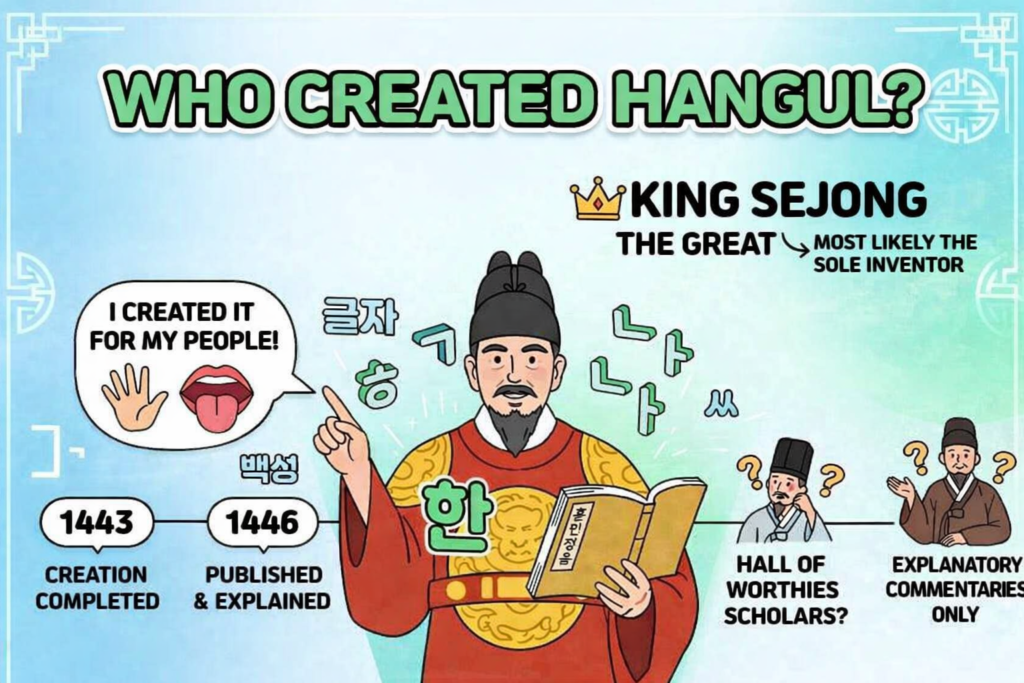
If you want the clearest direct answer, here it is: King Sejong the Great created Hangul. Official Korean language sources state that contemporary records such as the Annals of the Joseon Dynasty and the preface associated with Hunminjeongeum consistently emphasize that Sejong himself created the script. UNESCO likewise identifies Sejong as the king who completed its development in 1443.
That is why most educational materials, museum explanations, and introductory articles do not hesitate to name King Sejong as the creator. In normal usage, saying “King Sejong created Hangul” is both natural and historically grounded. It is the most accurate short answer to Who created Hangul? for a general reader.
Why is King Sejong recognized as the creator?
King Sejong is recognized as the creator of Hangul not simply because he was the king, but because the historical record places him at the center of the script’s invention. Korean language authorities explain that the idea that Sejong merely ordered others to create Hangul is not strongly supported by the core records; instead, those records stress that he personally created it.
This matters because Hangul was not introduced as a decorative court project. It was created to solve a practical problem. Before Hangul, written communication relied heavily on Chinese characters, which made literacy much harder for ordinary Korean speakers. The original purpose of Hunminjeongeum was to provide a writing system better suited to the Korean language and easier for people to learn. That purpose is one reason Sejong’s name remains inseparable from the question Who created Hangul?
Did the Hall of Worthies also create Hangul?
This is where many readers get confused. When people ask Who created Hangul?, they often hear about the Hall of Worthies, also known as the scholarly institute that served the Joseon court. So did those scholars create Hangul too? The safest answer is: King Sejong is the creator, while the Hall of Worthies scholars helped explain and document the system, especially in the commentaries.
UNESCO explains that the 1446 Hunminjeongeum manuscript includes the Haerye, or explanatory commentaries, by scholars of the Hall of Worthies, including Jeong In-ji. Korea’s heritage materials also describe the book as containing Sejong’s main text together with explanatory sections written by his officials. So if you are writing a precise blog post, it is better not to say “the scholars created Hangul instead of Sejong.” A stronger and more accurate formulation is that Sejong created Hangul, while court scholars played a major role in interpreting, organizing, and commenting on it.
That balance is important. If you erase the scholars, the story becomes too simple. If you erase Sejong, it becomes misleading. For SEO and trust, the cleanest answer to Who created Hangul? is still King Sejong, with the added note that scholars of the Hall of Worthies contributed to the explanatory tradition surrounding it.
Hangul and Hunminjeongeum: are they the same?
Another reason people keep searching Who created Hangul? is that they run into two different names: Hangul and Hunminjeongeum. These are closely related, but they are not just random interchangeable labels without context. UNESCO explains that the original manuscript is called Hunminjeongeum, and that this is the Korean alphabet now called Hangul. In other words, Hunminjeongeum was the original name tied to the historical publication, while Hangul is the name most people use today.
That means a more polished sentence would be: King Sejong created Hunminjeongeum, which is now called Hangul. For everyday readers, “King Sejong created Hangul” is still perfectly fine. But if you want the article to feel more informed and credible, adding this distinction improves the quality immediately.
What happened in 1443 and 1446?
This is one of the most overlooked parts of the topic. Many people know one year but not the other. UNESCO states that Sejong completed the development of the script in 1443, and that the surviving Hunminjeongeum manuscript was published in the ninth lunar month of 1446. Korean language sources also discuss how the 1446 record is tied to the completion or publication of the book and its explanatory material, not just a simplified “one-day invention story.”
So the cleanest summary is this: 1443 refers to the completion of the script’s creation, and 1446 refers to the publication of the Hunminjeongeum text with its explanations. Some popular summaries use the phrase “created in 1443 and promulgated in 1446,” and that shorthand remains common, but official Korean language discussions add more nuance to the 1446 side of the story.
If your goal is to answer Who created Hangul? in a way that feels more authoritative than a basic textbook line, this distinction helps a lot. It shows that you are not only naming the creator, but also explaining the timeline correctly.
Why this question still matters today
At first glance, Who created Hangul? may look like a simple history question. In reality, it is also a cultural question. Once you know that King Sejong created the script to make literacy more accessible, Hangul stops looking like just another national writing system. It becomes a deliberate response to a real communication problem. That is a large part of why Sejong continues to be so deeply respected in Korea.
This is also why Hangul attracts attention far beyond Korea. The script has a clearly explained origin, a practical purpose, and a documented structure. For language learners, that makes it easier to appreciate. For readers of history, it makes the subject memorable. And for bloggers targeting the keyword Who created Hangul?, it means the strongest content is not just the name “King Sejong,” but the full story around that name.
Who created Hangul? Frequently asked questions
Who created Hangul?
King Sejong the Great is the standard and historically grounded answer. Official Korean language sources and UNESCO both place him at the center of its creation.
Did court scholars create it instead of Sejong?
The evidence most strongly supports Sejong as the creator. However, scholars of the Hall of Worthies helped provide the explanatory commentaries and examples preserved in the Hunminjeongeum tradition.
Was Hangul always called Hangul?
No. The original historical name was Hunminjeongeum. “Hangul” is the name widely used today.
What is the difference between 1443 and 1446?
1443 is the year UNESCO identifies as the completion of the script’s development, while 1446 is the year of the surviving manuscript’s publication and explanatory tradition.